Category Archives: A1 Baseball, General

Scoring the Old Fashioned Way ~ Paper and Pencil!

Book Review

“HOW TO SCORE BASEBALL, Advanced Edition” By Robert Bulka
This is a comprehensive, well-written book that could easily have been titled “Everything you always wanted to know about scoring a baseball game, but were afraid to ask.”   It’s been years since I’ve scored a game but I wasn’t the least bit daunted in reading the book. I mean how many things could have changed in the last few decades?  A hit’s a hit, a ball’s a ball and a run’s a run.  Well to start with a hit isn’t necessarily a hit as Robert carefully points out in his score keeping basics.

Standard Baseball Scorecard

But this isn’t your ordinary book.  This is a book full of instruction and explanation that helps the reader understand “why” each entry must be carefully entered into a specific area on the scorecard.  It’s a how-to book that’s actually fun as I felt like a school kid learning something for the first time.  And actually I was, as I realized the method I’d learned to score back in the old days was the most basic of basics.  This is the real thing, as it gets into not only runs, hits and errors, but takes you into recording unusual situations such as the four strike-out inning, catcher’s interference and the double switch and much more.
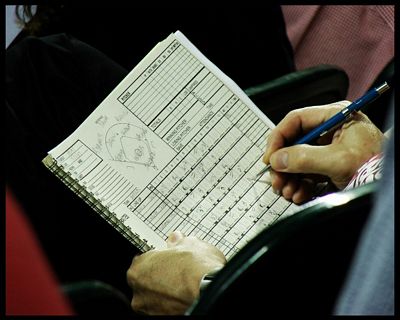
“Scorekeeper photo courtesy of Google Images”

I’m an accountant by trade so one of the more interesting aspects of the scorekeeping was “Proving a Box Score”, or how to be sure your book is in balance so to speak.   But my favorite was the list of formulas the author included for calculating statistics.  If you’ve struggled with Sabermetrics this is a great primer for learning how the various percentages are calculated.

The book is available in Kindle and PDF format, but I’d really love to be able to read it in a regular book format also. The information available in this great little book is such a great resource I’d have the pages folded and yellow highlighting and post-its on every other page.

In case you’re not aware, you can download a Kindle book even if you don’t have a Kindle.  It can be downloaded to any PC, laptop and/or Kindle.

I’m aware there are a lot of electronic scoring systems out there, but to be honest I don’t see how you could become a very good scorer without understanding how and why you’re entering information in a specific place.  This will teach you to do that.

I really enjoyed this book and I’d recommend it to anyone who’s learning to score for the first time or for someone who just needs a refresher course.  Today my new score book arrived in the mail and I can hardly wait to settle in and begin practicing my new-found skills with Bulka’s handy little e-book by my side.

“How to Score Baseball”  is available for purchase through Amazon.com.

“Homer at the Bat” Video

I never saw this “Simpson” segment when it first appeared on the telly.  Thanks to Deadspin for recreating it for us.   I really like most of the “Deadspin” blogs but this is  only one of a handful I’ve been able to share with you, ours being lily-white and theirs being, well, um, colorful.   This Deadspin blog’s titled, “The Making of Homer at the Bat. The Episode that Conquered Prime Time 20 years Ago Tonight” (February 20).   I found the article totally entertaining.

Consider this little fluff-post a jump start as we head into spring training ~ I mean a gal’s gotta do something.  Can’t just sit around and twiddle our thumbs waiting for opening day you know …

Baseball Stats 101~ Scoring the Four Strike-out Inning.

MLB Pitchers and Catchers report to Spring Training today and it seems like as good a time as any to get those score books out of the closet and settle in for a refresher course. Last spring I wrote an article about the 4 Strike-Out Inning and asked you if anyone knew how to score it. No one did, at least no one responded. Robert Bulka to the rescue! Robert’s written a book and several articles on how to go about scoring a ballgame and he’s generously offered to give us a lesson on the subject.  I love this stuff!

How To Score Baseball – The Four Strikeout Inning

It’s one of the most peculiar situations in all of baseball, a pitcher striking out four players in one inning. Not only is it an odd situation, it’s one of the rarer baseball situations you would record in a baseball scorebook.

The four strikeout inning occurs when a batter swings and misses on strike three but the catcher misses the ball. The batter then runs and reaches first base before being tagged out.

Two conditions must be met for a pitcher to strike out 4 batters in one innings: 1) with less than two outs there cannot be a runner on first base and 2) the catcher makes an error catching the third strike and the batter reaches base safely. Technically, a 4 strikeout inning could occur if a batter swings at a wild pitch on the third strike, and reaches base safely.

When scoring the 4 strikeout inning in a baseball scorebook, the pitcher is still credited with a strikeout, and an error is charged to the catcher (if the catcher missed the third strike “E2”) or the pitcher (if the third strike was a wild pitch “E1”).

This at-bat would be recorded as a “K” (swinging strikeout) and E2 (error on the catcher) in the scorebox of the batter.

So let’s take the situation where the first two batters in the inning strikeout swinging and the third batter strikes out swinging but reaches first base and the fourth batter strikes out swinging to retire the side.

1st batter: Jones strikes out swinging on 1 ball 2 strike pitch.

Write a “K” on the baseball scorecard to denote a strikeout swinging. In the top right hand corner enter “1” and circle it to denote the first out. The dots in the boxes represent the count on the batter at the end result of his at-bat.

2nd batter: Adams strikes out swinging. Write a “K” in the box to denote a strikeout swinging. At the top right had corner enter “2” and circle it, to denote the second out of the evening. Again, the dots represent the count when the batter struck out.

3rd batter: Smith swings at third strike but the catcher misses the ball and the he reaches first base safely. Write a “K” in the scorebook AND “E2” to denote that the ball passed the catcher; hence the reason for batter reaching 1st base safely. Draw a diagonal line from Home to First “/” to denote the batter reached first base. The dots represent the fact that he swung and missed on a full count (3 balls 2 strikes).

4th batter: Odom strikes out swinging: Write a “K” on the baseball scorecard to denote a strikeout swinging. Draw a diagonal the under the player at-bat box to denote he made the last out of the inning. The dots represent he struck out on an 0-2 pitch.

A Little History About the Four Strikeout Inning

The first Major League player to be credited with this rare feat was Ed “Cannonball” Crane of the New York Giants on October 4, 1888.

The last player to achieve this feat was Yovani Gallardo of the Milwaukee Brewers, who struck out four batters in the fifth inning of a game against the Cincinnati Reds on September 17, 2011.

There have been a total of 57 4 out innings recorded in MLB history, 24 in the American League and 33 in the National League.

A five strikeout inning has never been recorded in MLB. However, it has happened in the minor leagues 3 times; and you can even begin to count how many times it has happened in amateur baseball.

Written by: Robert Bulka, author of How To Score Baseball – Advanced Edition

Loving Baseball … And No, Not Just Because it’s Valentine’s Day.

This is a repost from 2012 ~ because it’s always relevant!

It’s Valentine’s Day and I found the perfect little ditty to share with you.  I found it in all places in a teen magazine called,  “Teen Ink”.  Here’s an excerpt from the article:

“For the Love of Baseball”  by Joyce, Monterey Park, CA. We don’t just love baseball, don’t just watch baseball, don’t just talk about baseball – we live baseball and our team’s every season, every game, every inning, and every pitch. We cheer on the rookies and bow down to the retiring heroes. We drive home anxiously from work or school to catch the first pitch and stay up late to savor the closing of a great game. We feel the agony of errors, wild pitches, and blown saves. We argue balls, strikes, and close plays. We understand and can distinguish between double plays such as the 6-4-3 and the 5-4-3. We appreciate a sacrifice bunt/hit to advance runners, a cycle, a perfect game, a no-hitter, and base-by-base scoring more than a home run. We question the manager’s decision to go to the bull pen, call up a pinch runner, and give an intentional walk. We marvel at the eye-popping, breathtaking defensive plays. Baseball may seem to be a slow, boring game, but it is really an artwork of strategies, gambles, and patience. In the end, nothing brings more happiness and excitement than to relax after a long day and watch your team play. They’re down 1-0, at the bottom of the ninth, two outs, the rookie from the farm team gets a hit. A bunt to third base, and the kid is faster than the ball. He’s safe. It isn’t much, but there’s hope, because there’s always hope. There’s always the next inning, the next game, the next season. Comebacks happen, because nothing is ever the same. And when you jump up in exhilaration rejoicing the walk-off home run and watching your team celebrate like kids around home plate, then you will truly understand what it means to love baseball.

Game Shows and Crossword Puzzles ~ Get Your Baseball Smarts in Order!

Baseball's Einstein

If you want to practice and/or test your knowledge of all things baseball, here are a few little ditties you might be interested in.

BASEBALL I.Q.”   MLB Network’s first-ever game show is hosted by MLB Network’s Matt Vasgersian and airs Tuesdays through Thursdays at 9:00 p.m. ET.  It’s a  30 minute trivia show featuring two participants from opposing teams, with a chance to win up to $45,000 for charity.    I found out quickly how much I don’t know, but it’s still a lot of fun to play along.

Rick Swain ~ Baseball Crossword Puzzles

A  BASEBALL CROSSWORD PUZZLE?   Who knew?  Rick Swain has a great website that includes a weekly crossword puzzle all about baseball .  If you’re one of those fans who like to keep their baseball IQ skills honed, this is for you!  You can even sign up for a notification of Rick’s weekly crossword puzzle delivered right to your inbox.  Sign up through Rick’s website, Rick Swain Author of  Books About Baseball’s Unsung Heroes.

A Few Baseball Oddities ~ Statistically Speaking

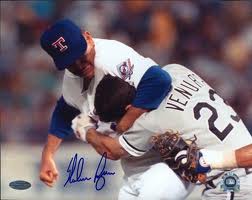
Nolan Ryan & Robin Ventura's friendly encounter after Ventura charged the mound. Photo Courtesy of Google Images.

Here’s a great post I found this morning from one of our GFBB’s Recommended Websites, William Miller’s “The On Deck Circle” .   Bill tends to write rather lengthy articles  so I’m posting a portion to peak your interest.  The complete article is linked  below.  It’s about the pitchers deemed the hardest to hit in all of baseball and includes some of the best and worst in other positions.  I think you’ll enjoy this.

February 6, 2012   William Miller’s  “On Deck Circle”

BASEBALL STATISTICAL ODDITIES

Every once in a while, as I’m doing some research for this blog, I’ll come across a baseball statistic that catches me off guard.

I’m not suggesting that no one else has ever noticed any of these odd items before, but if they are new to me, they might just be new to you, too.

To begin with, which particular pitchers in baseball history do you think were the toughest to hit against (Hits / 9 Innings)?

Did you say Walter Johnson?  Well, O.K., he is 33rd on the all-time list having given up 7.47 hits per nine innings in his career.  Randy Johnson?  You’re getting warmer.  He is 22nd on the list.

Remember, we are not talking about WHIP here.  Just hits per nine.

Yes, of course, it was Nolan Ryan.  He was the Number #1 toughest pitcher to hit, having given up just 6.55 hits per nine.  Not a surprise.  But keep reading.  (Click here to continue reading the complete article from Bill Miller’s The On Deck Circle.)

Braving the Fan Fest at AT&T Park!

This slideshow requires JavaScript.

Photos courtesy of KNBR and Ronni Redmond

I made up my mind last year that no matter what happened, I was going to the Fan Fest this year!   And I did.  We, my husband and I, always take Cal-Train to Giants games at AT&T Park just to avoid the parking and we did the same today.  It’s a few blocks to the ballpark from the train station and it’s the perfect way to travel stress-free to the games.

All the stories about the crowds proved true again this year.  Rumor has it the crowd was around 35,000 but to tell you the truth we avoided all of that.  I leave the autograph-seeking to the youngsters  so we headed up to the club level and found a perfect spot, a little to the right of  home plate,  front row, seats 1 and 2.  And we settled in for the day with our perfect seats for some perfect photo’s and perfect weather.  I loved this.   And we had a fantastic view of the KNBR Broadcast Stage and could hear the interviews and conversations as though we were sitting right there with them.   We had a great time at the park today!

Baseball season is finally here.  Almost.  But it’s close enough you can reach out and touch it, feel it.  Tomorrow’s Super Bowl Sunday which is probably great if you’re a football fan.  Oh okay,  I have to admit I did get a little taken up with the Tebowing  thing this year, but honestly can you truly say there’s anything better than spring training and opening day of baseball?   I’ve been waiting for this since the 7th  game of the world series last year and it’s just as good as I’d hoped it would be.  Thank you God. Baseball, one of the many pleasures in life.

You might remember a Bill Cosby video many years ago that included a story about little Jeffrey.  “Little Jeffrey” on the airplane.   On the one and one-half hour ride home  we had a little Jeffrey on the train.  Little Jeffrey screamed all the way home finally de-training just one stop before we did.  I watched him as his poor drained parents stepped off the train and  carried him past our window, little Jeffrey all smiles.  Our children are all grown now and gone, with children of their own.   But I remember the days.  Thank you again God.  Retirement, one of the many pleasures in life!

A SABR Day in Sunny San Francisco!

This slideshow requires JavaScript.

I’ve been a member of  the Lefty O’Doul Chapter of SABR,  Society for American Baseball Research, for a year now and this was the first function I’ve been able to attend.   I mention this because I wish I’d attended all the functions this past year and I had this thought that,  if you were exposed to the idea, you’d probably like to do the same thing.

Our day included a tour of AT&T Park, a video conference with the Hall of Fame in Cooperstown,  special guest speakers Henry Schulman, sport writer for the SF Chronicle and author Michael Duca, Chapter President, Marlene Vogelsang  and SABR National Director, Paul Hirsch giving us lots of good timely information.  It was a very good day in San Francisco!

So in recognition of  SABR Day in America 3″ this is an open invitation to anyone interested in finding out more about SABR to please check it out.   You’ll meet some really great baseball fans and be able to talk baseball all you want without having to deal with eyes rolling back in the head indicating “oh boy, here we go again”.  These guys get it! And so will you!

Fast Ball, Curve Ball, Slider ……What’s the Difference and Who Cares?

This video shows  a Tim Lincecum fastball and curveball delivery correlated at the release point and superimposed to provide an overlay comparison of the two motions.   The two pitches look nearly identical to my untrained eye. This YouTube video uploaded by  on June 18, 2009.

So I’m  listening to play-by-play of  a game the other day and the announcer says instantly “that was a fastball (curveball, sinker, slider, doesn’t matter … you get the point) and I’m thinking how the hell does he know that?  I mean the ball’s traveling at 90-95 mph and he’s up in the announcer booth 200 feet away.   I know this announcer used to be a pitcher  so I’m pretty sure he knows what he’s talking about, but how is that possible ~ to call the pitch instantly in split-second timing, almost before the ball’s even thrown?

I set out to research this so I might understand the difference between the  pitches and how a pitcher  might determine which pitch to throw and when to throw it. Continue reading

“Who’s On First” ….. Classic Baseball Video

I intended to blog about the Texas Rangers job opening for an “accountability partner” for Josh Hamilton but had second thoughts.  It seems a little heartless to  talk about it, maybe even a little sad, so when I found this little ditty out there in YouTube land it was an easy change-over.  This is light-hearted good stuff!

So in case you’ve never seen it and even if you have here’s a wonderful version of one of Abbott & Costello’s finest routines.  Abbott and Costello performed this classic “Who’s on first?” baseball sketch in their 1945 film “The Naughty Nineties” first performed as part of their stage act.   This video now plays continuously on screens at the Baseball Hall of Fame in Cooperstown, New York.

In 1999, Time Magazine named the routine the “Best Comedy Sketch of the 20th century.    And who’s to argue with them?   No matter how many times I’ve seen it, it’s a classic that never gets old.

You can read all about it at Wikipedia, but not on Wednesday, January 21, as they’re having a “black-out” to protest the Freedom of Information Act being proposed in Congress.

“Who’s on First”  YouTube Video courtesy of, and uploaded by, on Feb 16, 2007.

This Day in History …… Hall of Fame Voters A Little Pickayunish!

January 10, 1945.  This Day In History baseball writers fail to elect a Hall of Famer as no one receives the required 75% vote.                                        

Yesterday on Twitter someone asked why a player would be elected to the Hall of Fame in subsequent years if they weren’t chosen in the first year.  After all, nothing had changed as far as the player was concerned, his statistics remain the same.

In 1945 Frank ChanceRube Waddell, and Ed Walsh came closest and, in fact, all three of them  were actually elected to the Hall the next year, in 1946.  What changed from 1945 to 1946 that  allowed these fellows to garner 75% of the votes, when they were unable to do so the previous year?

I found this a little puzzling and set out to research the people who actually do the nominating and selection and what the process is all about.  After about four hours, I gave up the search.  I ran into overwhelming statistics such as  only 296  have been elected to the HOF since 1936, out of a possible 17 quadrillion players (17,275,882,859,193,771 to be exact) who have played Major League Baseball.   (I’m an accountant by trade and still had to count backwards in three’s to come Continue reading

St. Louis Fans Missing Pujols? ….. Not so Fast!

Don’t get me wrong.  I’m a huge Albert Pujols fan.  But here’s another way to look at it, courtesy of Sully Videos with a little John Travolta thrown in.  Take a look ~